
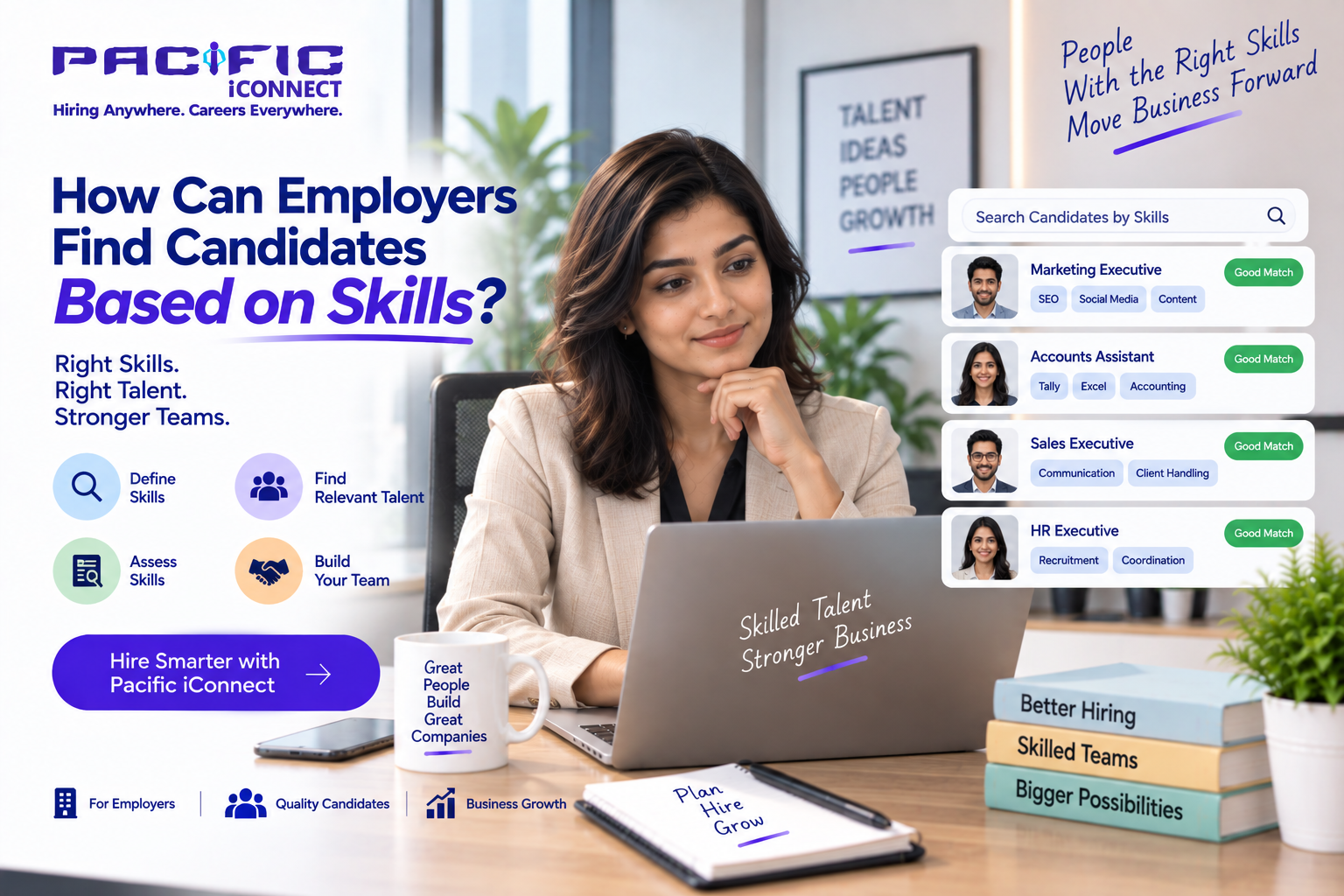
Finding the right candidate is not always about finding someone with the longest resume.
For many positions, employers need people with specific skills that match the actual requirements of the job.
A skill-based approach can help employers focus on what candidates can contribute rather than relying only on job titles or years of experience.
Here are some practical ways to do it.
1. Define the Skills Required for the Role
Before searching for candidates, employers should identify the skills that are genuinely necessary.
For example:
Sales Role: Communication, negotiation, customer handling
Accountant: Accounting knowledge, Excel, attention to detail
Back Office: Computer skills, data handling, accuracy
Digital Marketing: SEO, social media, content and analytics
Separating essential skills from preferred skills can make candidate screening more focused.
2. Create a Skills-Based Job Description
A job description should clearly explain what the candidate needs to do and which skills are required.
Include:
- Job responsibilities
- Essential skills
- Qualification
- Experience
- Location
- Salary
- Job type
Clear requirements help candidates understand whether they are suitable before applying.
3. Look Beyond Job Titles
Job titles can vary between companies.
One employer's Sales Executive may have different responsibilities from another employer's Sales Executive.
Instead of relying only on titles, look at:
Responsibilities + Skills + Previous Work
This can reveal whether a candidate's experience is actually relevant.
4. Review Practical Experience
Skills can be demonstrated through more than full-time employment.
Employers can consider:
- Previous projects
- Internships
- Freelance work
- Certifications
- Practical assignments
- Relevant personal projects
This is especially useful when hiring freshers or candidates with limited experience.
5. Use Skill-Based Screening
During initial screening, compare candidate profiles against the most important requirements.
A simple process can be:
Job Requirements → Candidate Skills → Relevant Experience → Shortlist
For example, if Excel is essential for a position, candidates with relevant Excel experience can be given appropriate attention during screening.
6. Conduct Practical Assessments
A practical test can provide useful information about a candidate's actual ability.
Examples:
Excel Role → Spreadsheet task
Content Role → Writing sample
Sales Role → Communication exercise
IT Role → Technical assessment
The assessment should be relevant to the actual position.
7. Evaluate Soft Skills Too
Technical skills are important, but some positions also require strong soft skills.
Depending on the role, employers may consider:
- Communication
- Teamwork
- Problem-solving
- Adaptability
- Time management
- Customer handling
The importance of each skill will depend on the job.
8. Don't Automatically Reject Candidates with Less Experience
A candidate may have limited experience but possess the skills required for the position.
For suitable entry-level roles, employers can consider:
Skills + Education + Projects + Learning Ability
rather than using years of experience as the only screening factor.
9. Use Online Recruitment Platforms
Online recruitment platforms can help employers reach jobseekers across different roles and locations.
Pacific iConnect provides an online platform connecting employers and jobseekers, allowing businesses to present vacancies and reach potential candidates.
Employers can use the platform to communicate their job requirements and connect with people looking for suitable opportunities.
A Simple Skills-Based Hiring Process
Define Required Skills
↓
Create Clear Job Description
↓
Search Candidate Profiles
↓
Match Skills
↓
Assess Practical Ability
↓
Interview
↓
Select Suitable Candidate
Employer Skills Checklist
Before shortlisting a candidate, ask:
☑ Does the candidate have the
essential skills?
☑ Is their experience relevant?
☑ Do their qualifications match the role?
☑ Can they demonstrate the required abilities?
☑ Do they understand the responsibilities?
☑ Are the location and availability suitable?
Final Thoughts
Skills-based hiring helps employers focus on what candidates can actually contribute to a role.
Experience and qualifications still matter, but they can be considered alongside practical skills, projects, communication and job-specific abilities.
The goal is simple:
Find the skills the role needs, then find candidates who can demonstrate them.